What Losing a Perfect Site Taught Me About Patience and Timing the Market

The Rules Have Changed for Good
Every investor has a deal that still stings a little.
Mine was a few years ago, right when the market was running hot.
It was a tidy corner block on Brisbane’s south side with the right zoning, solid frontage, no overlays. The agent told me interest was strong but not crazy. I ran the numbers and saw a clear upside.
It felt like the one.
I’d just wrapped another subdivision and had cash ready to go but a couple of red flags appeared:
- Build costs had jumped 12% since my last project.
- Council turnaround times were blowing out past six months.
- Finance approvals were tightening.
I hesitated, thinking I’d wait for one more quote before signing the contract.
Two days later, it went under offer.
At first, I was gutted. I even questioned my instincts. But a few months later, as construction costs climbed again and the market plateaued, I realised walking away was one of the best decisions I’d made.
What I Learned About Timing the Property Market
Losing that site taught me more than any success story ever could. It showed me how critical timing is – not just in the sense of market cycles but in aligning your own position, risk tolerance and resources with the opportunity in front of you.
Here’s what experience (and a few scars) have taught me about reading timing properly.
1. Know Which Cycle You’re Playing In
Every project has a rhythm.
When interest rates are high, deals with long settlements or option clauses give you breathing room. When demand is rising and builders are hungry, fast-turn deals make more sense.
At the time I missed that “perfect” site, the market was overheated. Builders were booked solid, approval times were dragging, and finance was tight. The numbers looked fine on paper but the timing made them fragile.
That’s where a lot of investors trip up… They run a static feasibility in a dynamic market.
If conditions are changing faster than your spreadsheet, the safest move can be no move at all.
2. Match Your Cash Flow to Your Timeline
Patience in property isn’t about sitting on the sidelines. It’s about being ready when the right window opens.
When I look back, I realise I didn’t have enough liquidity for the holding period that project would’ve required. If approval delays had stretched to eight or nine months, I’d have been bleeding interest while waiting for progress.
Now, whenever I review a deal, I stress-test it for time.
If it takes twice as long as planned, does it still work?
If not, I pass.
That small question has saved me more stress than any spreadsheet tweak ever could.
3. Patience Doesn’t Mean Inactivity
After losing that deal, I stayed active… Talking to agents, checking council DA trackers, and walking sites every weekend. I wasn’t chasing every listing, just staying close to the market so when something aligned, I could move quickly.
Three months later, that exact discipline paid off. I found another site nearby, same zoning, easier services, and a more flexible vendor. Because I’d kept my broker, planner, and builder on standby, I signed the contract within 48 hours.
It turned out better in every way.
Patience paid off, but only because the groundwork never stopped.
4. Learn to Read the “Micro-Timing”
People talk about property cycles as if they’re national events. In reality, each suburb, sometimes each street, has its own micro-timing.
When approvals slow down in one council, others often speed up. When one builder’s pipeline is full, another is finishing jobs and ready to start.
Timing isn’t luck. It’s awareness.
Talk to surveyors, brokers, agents, and builders weekly. Those conversations show where supply is tight, who’s negotiating harder and when sentiment is shifting.
The best investors I know read those signals better than any headline.
5. Not Every Opportunity Is Yours to Take
This might sound counter-intuitive, but it’s an important mindset shift.
Just because a deal is profitable doesn’t mean it’s yours to execute.
Sometimes the project suits someone else’s resources, contacts, or stage of the journey. The sooner you can recognise that, the faster you can refocus on the deals that fit you.
It’s taken me years to accept that truth… but it’s kept me safe through volatile markets.
A Real Example From the Field
One of our long-term members had a similar experience. She missed out on a duplex site in 2022 that looked like a winner.
Six months later, the purchaser finally broke ground after battling design issues and cost overruns. She picked up another site two streets away that was smaller, simpler, lower holding costs and sold both homes before the other build even finished.
That’s the market in a nutshell. The smart money doesn’t chase perfect sites. It finds the ones that finish.
How to Apply This Right Now
If you’re looking at deals in 2026, here are three quick filters that help you judge timing fast:
- Council Lead Times: Ask your planner for current approval durations before locking in a finance period.
- Builder Capacity: Get at least two quotes and ask about start dates, not just prices.
- Finance Certainty: Pre-approval windows are shorter now, so check your expiry date before committing.
If all three line up, you’re in good timing territory. If even one lags, pause and reassess.
Final Reflection
Missing that “perfect” site was a reminder that progress in property isn’t measured by how many contracts you sign but by how well you choose.
Good deals reward discipline.
Markets reward patience.
Momentum rewards preparation.
Timing the property market isn’t about predicting peaks and troughs… it’s about understanding when you are ready to act.
Get that balance right, the next “missed” deal won’t feel like a loss… It’ll feel like preparation for the better one just around the corner.
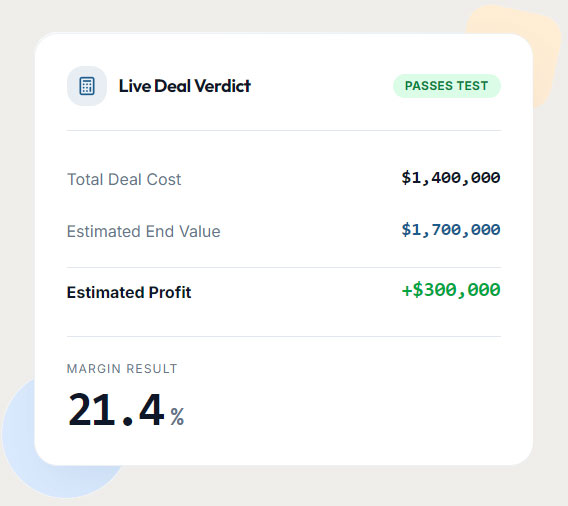
Know If a Property Deal Is Worth Pursuing, in Under 2 Minutes
Use the same framework experienced investors use to quickly filter renovation, subdivision, development and buy & hold deals, before wasting weeks on the wrong one.
0 thoughts on "What Losing a Perfect Site Taught Me About Patience and Timing the Market"