Money Mindset Part 3: Turning Confidence Into Calm Execution
Confidence is overrated.
Calm execution is not.
Over the years I have seen investors swing between two states. Early on they lack confidence and hesitate. Later, after a few wins, confidence grows and momentum builds.
But confidence alone does not create long term results.
Execution does and the best execution is calm.
The Problem With Emotional Confidence
Emotional confidence feels powerful.
It shows up after a good deal. After strong growth. After positive feedback from peers. It creates energy and momentum.
The risk is that emotional confidence can turn into speed.
You move faster. You commit quicker. You assume things will work because they have worked before.
There is nothing wrong with confidence.
The issue is when confidence replaces structure.
If you loosen your margin because you feel good about the market, that is not growth. If you rush feasibility because you trust your instinct, that is not maturity.
Confidence without discipline creates exposure.
What Calm Execution Looks Like
Calm execution is quieter.
It does not need to prove anything. It does not rush to keep up with others. It does not chase bigger numbers for the sake of ego.
It asks simple questions:
Does this meet my margin?
Have I allowed for variation?
Is the downside acceptable?
Then it decides.
Calm operators are procedural. They follow their filters even when they feel excited.
They walk away even when the opportunity looks attractive on the surface.
They understand that long term wealth is built through repeatable behaviour, not bursts of enthusiasm.
Turning Awareness Into Structure
Awareness alone is not enough.
You need to convert it into something practical.
Here is a simple exercise you can implement immediately.
First, define your non-negotiables in writing. Your minimum profit on cost. Your buffer percentage. Your maximum acceptable downside scenario. Do this when you are calm, not when you are analysing a live deal.
Second, create a pre-commitment checklist. Before making an offer, force yourself to answer the same set of questions every time. Does this deal meet my margin? Have I stress tested the end values? What happens if build costs rise by ten percent?
Third, introduce a 24 hour rule on major commitments. When a deal feels exciting, step away for a day. Revisit the numbers with neutral energy. If it still meets your criteria, proceed. If not, walk.
These small disciplines create emotional distance.
They turn confidence into controlled execution.
Confidence That Is Earned
The kind of confidence that supports execution is not loud or urgent.
It is built from pattern recognition.
You have seen delays before and handled them. You have absorbed variations. You have walked away from marginal deals and later been grateful.
That experience builds internal stability.
You no longer need the deal to work. You no longer feel behind. You no longer rush for certainty.
You assess and act.
That shift is subtle but powerful.
Final Thought
Money mindset is not about thinking bigger.
It is about thinking clearer.
Clearer about your beliefs. Clearer about your pace. Clearer about your standards.
The investors who build lasting results are not the most confident in the room.
They are the most consistent.
Confidence fluctuates.
Structure compounds.
If you combine awareness with disciplined execution, you do not need to chase.
You simply operate.
If you’ve missed out, you can catch up here for Money Mindset Part 1 or Money Mindset Part 2.
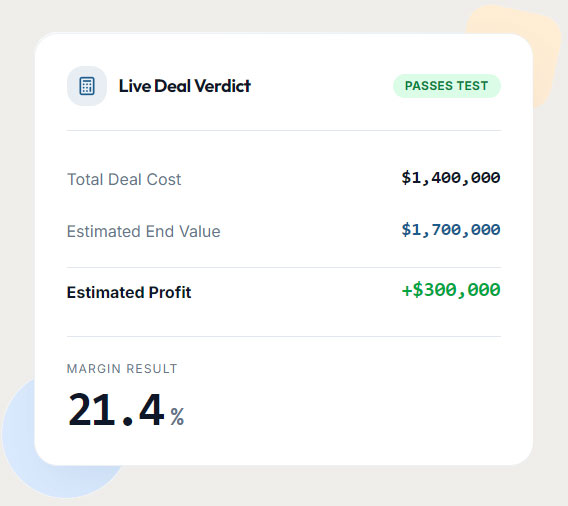
Know If a Property Deal Is Worth Pursuing, in Under 2 Minutes
Use the same framework experienced investors use to quickly filter renovation, subdivision, development and buy & hold deals, before wasting weeks on the wrong one.
0 thoughts on "Money Mindset Part 3: Turning Confidence Into Calm Execution"