Money Mindset Part 1: How Your Beliefs Quietly Shape Every Deal

Most investors think money mindset is about confidence.
It isn’t. It’s about belief.
Belief shows up in your decisions long before you realise it.
You can have a solid feasibility template.
You can understand margin, buffers and conservative assumptions but if your underlying beliefs about money are distorted, they will quietly shape every choice you make.
You don’t just analyse numbers, you interpret them and interpretation is influenced by belief.
I learned that the hard way.
The Invisible Ceiling
Early on I had a belief that I was worth about sixty thousand dollars a year.
Back in 2005, I had worked my way into a managerial role earning around that amount. At the time, it felt like a lot of money and without realising it, I built an internal ceiling around that number.
When I moved into property, I carried that belief with me.
For the life of me I could not make more than sixty thousand dollars on a project.
Deals would plateau around that mark. If they crept higher, something would go wrong or I would unconsciously tighten up.
It was as if that number was my comfort zone.
At one point I genuinely thought, what is the point of doing property if I can just go back to a job and earn a wage with no risk and no capital required.
The problem was not the deals, it was the belief.
How Belief Shapes Behaviour
This did not show up as fear, it showed up as strategy.
I thought small.
I looked at renovations I could comfortably afford rather than projects that had genuine scale. I told myself I was being prudent. In reality, I was matching my deals to what I believed I was worth.
There was no expansion in my thinking. No larger vision. The strategy aligned perfectly with the ceiling I had set internally.
Two investors can look at the same opportunity and interpret it differently.
One sees manageable risk and upside, the other sees danger and pulls back.
The numbers are identical – the filter is not.
If someone believes money is fragile and hard to replace, every variation feels threatening.
If someone believes money flows and can be recreated, they approach risk differently.
Neither extreme is ideal but awareness matters.
Your belief about money determines how much pressure you feel when a deal tightens.
It influences how hard you negotiate. It shapes whether you stretch assumptions or walk away.
It rarely feels like belief, it just feels like instinct.
What Changed?
The shift for me started with personal development work around belief systems.
I began questioning where my views about money came from.
Many of them were old, built in childhood, carried forward without being examined.
Once I acknowledged them, they were surprisingly easy to change.
It was like peeling back layers. I realised those old beliefs were not serving me anymore. That opened the door to a more abundant way of thinking.
The external shift followed quickly.
I moved into subdivisions. They required more capital up front but they offered stronger margins and clearer exit strategies.
The first one into two subdivision I completed made more profit in that single deal than I was earning in a year as a postie at the time.
That deal broke the ceiling.
It was instructional.
I created a block of land by adding a boundary, kept the existing house, sold the rear block and later sold the improved asset for a profit.
It was structured. Logical. Repeatable.
From that point forward, the number of zeros stopped being intimidating. I was no longer focused on what I thought I was worth. I was focused on risk, margin and structure.
The deals changed because the belief changed.
Scarcity and Overconfidence
Not everyone’s ceiling looks like mine did. Some investors operate from scarcity and overprotection, others operate from overconfidence and loose discipline.
Both are belief driven.
Scarcity leads to waiting for certainty that never arrives. Overconfidence leads to shaving margin because you assume you will figure it out later.
Money mindset shows up inside feasibility.
Do you assume conservative end values or optimistic ones?
Do you build real buffers or convince yourself you will not need them?
Do you cling to marginal deals because you believe opportunities are rare?
These are not purely technical decisions, they are belief filtered decisions.
Bringing It Back to Process
The goal is not blind abundance thinking.
It is awareness plus structure.
Clear margin thresholds. Conservative assumptions. Defined walk away rules.
Structure protects you from both scarcity and overconfidence.
Once my belief ceiling shifted, I still ran conservative numbers. I still respected risk. The difference was I no longer felt limited by an internal number.
I evaluated deals on fundamentals, not on what I thought I deserved.
Final Thought
Money mindset is not about positive thinking.
It is about recognising that your beliefs are quietly shaping your behaviour.
The moment you become aware of your ceiling, you can raise it.
In the next part of this series we will look at why some investors always feel behind, even when they are progressing. Comparison is another belief pattern that distorts decision making.
For now, consider this, are your deals reflecting market reality?
Or are they reflecting what you believe you are worth?
If you’ve missed out, you can catch up here for Money Mindset Part 2 or Money Mindset Part 3.
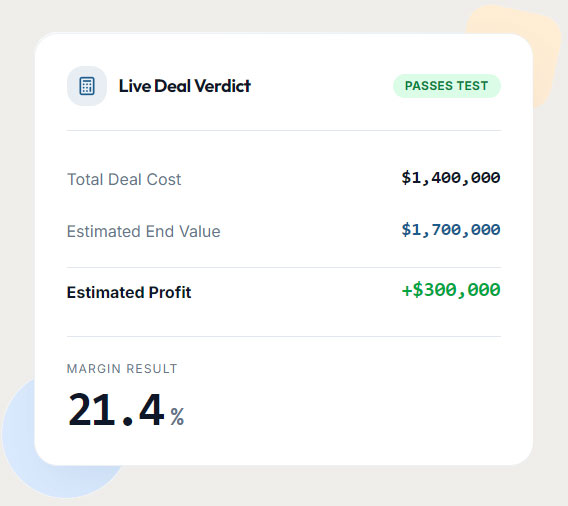
Know If a Property Deal Is Worth Pursuing, in Under 2 Minutes
Use the same framework experienced investors use to quickly filter renovation, subdivision, development and buy & hold deals, before wasting weeks on the wrong one.
0 thoughts on "Money Mindset Part 1: How Your Beliefs Quietly Shape Every Deal"