How I Think About Joint Ventures Now

Joint ventures are one of the most misunderstood parts of property investing.
Some people see them as a shortcut. Others see them as risky or complicated.
Over the years I’ve seen them work extremely well and I’ve seen them unravel quietly.
My view on joint ventures has changed. Not because they don’t work but because I understand more clearly what actually makes them work.
A Joint Venture Does Not Fix A Weak Deal
Early on, many investors look at joint ventures as a way to access deals they could not otherwise do. They lack capital or serviceability so they look for a money partner.
There is nothing wrong with that in principle.
The problem is when the joint venture becomes the solution to a marginal deal.
If the feasibility is tight before a partnership, it will be tighter after profit is split. If the structure is unclear before bringing someone in, it will become more fragile once expectations enter the picture.
A joint venture does not improve a deal, it amplifies whatever is already there.
If the fundamentals are strong, it can accelerate growth. If they are weak, it magnifies tension.
Alignment Is More Important Than Capital
Over time, I have realised that financial contribution is rarely the hardest part, alignment is.
Do both parties see risk the same way? Do they have similar time horizons? Are they comfortable with normal development friction? Do they understand that variations and delays are part of the process?
Misalignment rarely explodes early. It shows up midway through a project when pressure increases. One party becomes nervous. The other becomes frustrated. Communication tightens.
Money is easy to document. Expectations are harder.
The strongest joint ventures I have seen share three traits. Clear roles. Clear communication. Clear contingency plans.
Not just optimistic projections.
Pressure Changes People
Another lesson that only comes from experience is this.
Pressure reveals personality.
When timelines move or costs shift, how does each party respond? Do they default to blame or to problem solving? Do they look for exit or for adjustment?
A joint venture is not just a financial agreement. It is a partnership under pressure.
Before entering one, I now think less about spreadsheets and more about temperament.
Can I handle friction with this person? Can they handle it with me?
If the answer is uncertain, that uncertainty matters.
The Real Purpose of a Joint Venture
At its best, a joint venture is not about filling a gap, it is about combining strengths.
One person may bring capital, another may bring deal flow and execution capability. When those roles are clear and respected, the structure can be powerful.
But when both parties are unclear on responsibility, accountability becomes blurred. That is where stress builds.
Clarity up front feels slow and sometimes uncomfortable. Skipping that clarity is far more uncomfortable later.
How I Approach Them Now
My thinking now is simpler.
If I would not do the deal on my own because the margin is weak or the risk is unclear, I will not do it in a joint venture.
If roles are not defined clearly, I will not rely on goodwill to fix that later.
If communication feels strained early, I treat that as data not as something to overlook.
Joint ventures are neither magic nor dangerous by default. They are neutral structures.
The strength comes from the people and the deal underneath them.
Final Thought
A well structured joint venture built on a strong deal and aligned expectations can accelerate growth significantly.
A poorly aligned one can set you back financially and emotionally.
The difference rarely lies in the spreadsheet.
It lies in clarity, alignment and discipline before the pressure begins.
That is how I think about them now.
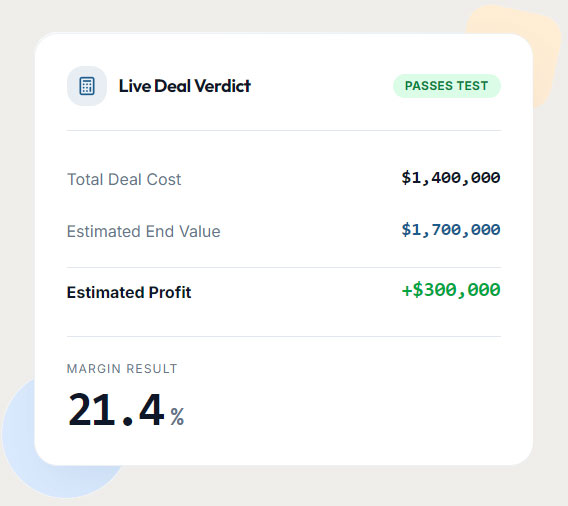
Know If a Property Deal Is Worth Pursuing, in Under 2 Minutes
Use the same framework experienced investors use to quickly filter renovation, subdivision, development and buy & hold deals, before wasting weeks on the wrong one.
0 thoughts on "How I Think About Joint Ventures Now"