Before You Renovate: How to Add Value Without Wasting Money
Most people start a renovation by thinking about what they want to change. A new kitchen, a bigger deck, a swimming pool or perhaps an extension to create more living space.
But there’s a question worth asking before you start spending money.
Are you improving the property as a whole or simply making individual parts of it better?
It’s an important distinction because you can spend a considerable amount of money renovating a home without necessarily making it work better or adding the value you expected.
I recently sat down with Debbie Laporte from Orterra Home
to discuss exactly this. Deb’s been part of our property community for years through her landscape architecture business, Orterra. She’s also worked on one of my own properties, so I’ve experienced her approach firsthand.
With the launch of Orterra Home, Deb and her team are bringing that experience into a more complete approach to home design, looking at renovations, extensions, interiors and outdoor spaces together rather than treating them as separate projects.
We covered plenty of ground in the interview. Here are the lessons I think every homeowner or property investor should consider before starting their next renovation.
1. Start With the Whole Property,
Not the Renovation
One of the things Deb explained early in our conversation was that landscape architects are often brought into a project last.
By that stage, the house might already have been renovated, the extension completed and most of the budget spent. The owners then turn their attention outside, only to discover that some of those earlier decisions have made it harder to achieve what they actually wanted.
Perhaps the deck doesn’t connect properly to the garden. The pool is in the wrong position or the outdoor entertaining area doesn’t work with the layout of the house.
These aren’t necessarily construction mistakes. They’re planning mistakes.
Deb’s approach is to understand what the owners are trying to achieve across the entire property before recommending individual improvements. That means considering how the family lives, how the spaces connect, what the property allows and where the money is best spent.
I think there’s a valuable lesson here for investors as well. We can become so focused on the renovation scope that we forget to assess how the finished property will actually function.
Sometimes the best improvement isn’t the one you originally had in mind.
2. The Expensive Mistakes Often
Happen Before Construction
A great example Deb raised was swimming pool placement.
Most people think about where the pool will fit, how much sunlight it will receive and how it will look from the house. But there’s another consideration that can completely change the way the outdoor area functions.
Pool fencing.
In Queensland, compliant pool barriers are a legal requirement. Depending on where the pool is positioned, that fencing can create an awkward separation between the deck, garden and entertaining areas.
Imagine spending a substantial amount on a new pool only to discover that the fencing interrupts the very indoor-outdoor connection you were trying to create.
The pool might look fantastic, but the overall property doesn’t work as well as it could.
That’s why the order of decisions matters. The pool, extension, drainage, levels and landscaping all influence one another.
Deb also made the point that installing a pool after completing the surrounding landscaping can mean damaging work you’ve already paid for.
A little more planning at the beginning can save a lot of rework later.
3. Where Should Your
Renovation Budget Actually Go?
This was one of my favourite parts of the conversation because it challenges how we tend to think about value.
I asked Deb how she helps clients prioritise when their wish list is bigger than their budget. Her answer came back to understanding what will genuinely improve the experience of living in the property.
She used a simple example from her own kitchen renovation.
Of all the improvements she’d made, one of her favourites was a pull-out rubbish bin positioned directly beneath the food preparation area. It wasn’t particularly expensive, but it made the kitchen significantly easier to use every day.
It’s a small example with a bigger lesson.
Not every valuable improvement needs to be expensive. Sometimes thoughtful design and better functionality deliver more benefit than premium finishes or additional floor space.
For investors, I’d take that thinking one step further. We need to distinguish between what adds value to the owner and what a future buyer is likely to pay more for.
Those aren’t always the same thing.
A $20,000 improvement doesn’t automatically add $20,000 to the property’s value. Equally, a relatively modest improvement can make a home more appealing without requiring a major renovation.
The trick is understanding your market and spending accordingly.
4. Renovating for Yourself
Is Different From Renovating for Resale
This distinction came through clearly in the interview.
If you’re renovating your own home, your personal preferences matter. You might want a particular kitchen layout, a larger outdoor entertaining area or a garden that suits how your family lives.
But if you’re renovating to sell, the decisions need to be driven more by the people who are likely to buy the property.
Deb gave the example of a home targeting young families. A bathtub, secure backyard and usable grassed area might be important features because they suit the needs of that buyer group.
For an older demographic, the priorities could be different. Lower-maintenance gardens, easier access and bathrooms that can accommodate changing mobility needs may have greater appeal.
It’s not about trying to please everyone. It’s about understanding who your likely buyer is and creating a property that works for them.
This is something I’ve always emphasised with renovation feasibility. You need to understand the end product before deciding what to spend.
There’s little point installing expensive features that your target market doesn’t particularly value.
5. A Difficult Site Can
Become an Opportunity
One of the more interesting examples Deb shared involved a property with a significant overland flow path and drainage problems.
At first glance, that sounds like a major headache. Water moving through a property can limit what you build, affect landscaping decisions and create ongoing maintenance issues.
Rather than simply treating the drainage as something to hide, Deb’s team incorporated a dry creek bed into the landscape design.
The finished result addressed the drainage problem while creating an attractive feature within the property.
I liked this example because it demonstrates a principle that applies well beyond landscaping.
A site constraint doesn’t automatically make a property a bad opportunity. It means you need to understand the constraint before deciding what to do with it.
I’ve seen similar situations with subdivisions where slope, trees, access or stormwater initially appear to be deal breakers. Sometimes they are. Other times, with the right professional advice, there’s a practical solution.
The important thing is to identify these issues early rather than discovering them after you’ve committed to an expensive design.
6. You Don’t Have to
Do Everything at Once
Another takeaway from our conversation was the value of having an overall plan, even if you can’t afford to complete everything immediately.
This is something I’ve experienced personally.
Deb helped us look at our own property as a whole, which made it easier to understand how the different improvements would eventually fit together.
We didn’t need to complete every component at the same time. But having that broader plan meant individual decisions could be made with the finished property in mind.
I’ve since pulled out those plans when speaking with different trades about work around our pool, decking, fire pit area and drainage.
That’s a practical benefit that’s easy to underestimate.
Instead of making isolated decisions every time a new trade arrives, you’re working towards a consistent outcome.
For homeowners, this can mean staging improvements over several years without having to undo earlier work.
For investors, it can mean planning the complete scope properly before deciding which improvements are financially justified.
Either way, the principle is the same. Plan the whole project, then work out what you can afford to deliver.
7. Three Questions to Ask
Before You Start Renovating
If you’re considering a renovation, here are three questions I’d encourage you to work through before calling the builder.
1. What problem am I actually trying to solve?
Be specific. Is the property too small, poorly laid out, difficult to maintain or simply looking tired? Are you improving your lifestyle or trying to manufacture equity? Different objectives require different solutions.
2. How will this decision affect the rest of the property?
Think beyond the immediate improvement. Will the extension reduce natural light? Could the pool position affect future landscaping? Are there drainage, access or level issues that need to be resolved first?
3. Will the improvement justify the money I’m spending?
For your own home, that might mean weighing up lifestyle benefits against the cost. For an investment property, it means understanding your target buyer, estimating the likely value uplift and checking that the numbers still stack.
You don’t necessarily need a complete set of architectural drawings to start answering these questions. In fact, getting the right advice before commissioning detailed plans may help you avoid heading in the wrong direction.
Why Getting Advice
Early Can Make a Difference
Towards the end of the interview, I asked Deb what someone actually needs before contacting Orterra Home.
Her answer was reassuring. You don’t need to have everything worked out.
Some clients begin with an initial on-site consultation where Deb and her team discuss the property, explore the owner’s goals and identify options they might not have considered.
She described a recent consultation where the owners were surprised by the possibilities raised during that first conversation.
That’s really the value of getting an experienced set of eyes on a property before committing to a particular solution.
It doesn’t mean every renovation needs a full design team. A straightforward cosmetic renovation may not justify that level of involvement.
But when you’re considering significant changes to a property’s layout, outdoor spaces or overall functionality, early design advice can be money well spent.
Final Thought
My biggest takeaway from the conversation with Deb was that good renovation decisions start well before construction.
It’s easy to become focused on the individual things we want to build. A new kitchen, a pool, an extension or a beautiful garden. But the real opportunity often comes from understanding how those improvements work together.
For investors, that means keeping one eye on the feasibility and the other on the finished product. For homeowners, it means making sure the money you’re spending genuinely improves the way you live.
Either way, you want to avoid spending money twice or creating compromises that could have been prevented with better planning.
If you’re considering a substantial renovation and aren’t sure where to start, it’s worth having a conversation with Deb and her team at
You can also learn more about their landscape architecture and development work through
And if you haven’t already, watch our full interview above. Deb shares plenty of practical examples that are worth hearing firsthand.
Cheers,
Matt
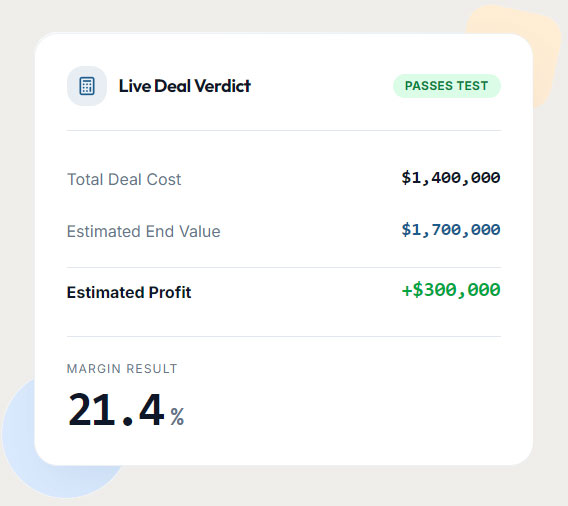
Know If a Property Deal Is Worth Pursuing, in Under 2 Minutes
Use the same framework experienced investors use to quickly filter renovation, subdivision, development and buy & hold deals, before wasting weeks on the wrong one.
0 thoughts on "Before You Renovate: How to Add Value Without Wasting Money"