The Invisible Cost That’s Killing Profit in Small Developments
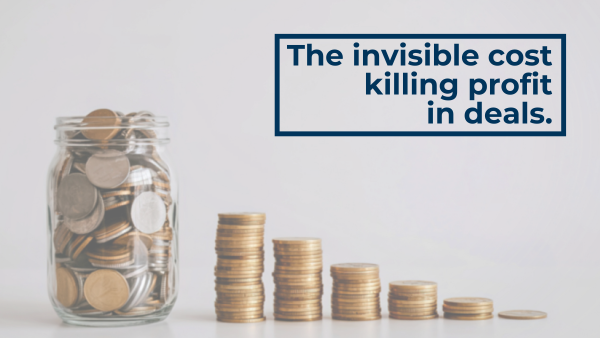
The Cost No One Talks About
Whenever people ask me what kills profit in small developments they usually expect the big scary stuff.
– Build cost blowouts.
– Council surprises.
– Bad soil.
– Stormwater nightmares.
Those things matter but they’re not the biggest risk.
The cost that quietly destroys deals is time.
Time is the invisible expense that compounds faster than any line item in your feasibility.
– Holding costs.
– Finance costs.
– Delays.
– Approvals that drag out.
– A builder who pushes your start date back three months.
– A survey plan that needs revision.
Your spreadsheet won’t scream at you when time slips but your profit will bleed every day nothing moves.
A Real Story From Mentoring
A client of mine picked up a clean splitter a while back. Numbers looked good. Build cost was locked in. Exit strategy was clear. Everything was lining up.
Then time stepped in.
– Council asked for extra information.
– The builder pushed his start date.
– Power relocation took longer because the provider was short on staff.
Small things but they stack up fast.
By the time he finished the project the costs hadn’t moved much but the timeline had doubled and so had the holding costs.
He still made money but it was half of what he expected purely because time slipped.
Why Time Is So Dangerous
You can budget for materials, you can budget for consultants and you can even budget for contingency.
It’s much harder to budget for time.
Time looks innocent at first… then it ramps up…
– your loan interest.
– your insurance.
– your council rates.
– your stress.
– your cash flow pressure.
A four month delay can be more damaging than a forty grand variation. I see it ALL the time.
The 2026 Problem No One’s Talking About
Time risk is bigger now than it was a few years ago.
– Builders are booked out.
– Olympics infrastructure is absorbing trades.
– Councils are understaffed.
– Approvals are slower.
– Certifiers are stretched.
– Engineers are juggling too much work.
Everything takes longer.
If you don’t factor that into your feasibility you’re taking on more risk than you realise.
How to Run a Time Sensitivity Test
This is something I teach a lot in mentoring because once people learn it they never look at a deal the same way again.
Step 1: Look at your ideal timeline from purchase to payday.
Step 2: Add 30% if the deal still works you’re in a healthy place.
Step 3: Add 50% if the deal still works you’ve got a winner.
Step 4: Ask yourself, “How many people need to do their job on time for this to stay on track”? The more people involved the higher the risk.
Simple deals win because there are fewer moving parts. Fewer dependencies. Fewer delays.
The Hidden Tax Inside Every Deal
Time creates a hidden tax that most investors don’t see until it’s too late.
That tax shows up as higher interest, extra holding costs, lost energy, extra consultant fees and slower capital recycling.
The slower your project moves – the slower your money grows.
Speed isn’t about rushing, it’s about removing friction.
The Deals That Win in 2026
In this market the projects that get funded, financed, approved and finished are the ones with tight, clean timelines.
– Small subdivisions.
– Straightforward builds.
– Simple renovations.
– One into twos.
– Anything with minimal council drag, minimal builder dependency or minimal design complexity.
Those are the deals that protect your profit.
A Mentoring Pattern I See Every Month
The investors who struggle aren’t lacking motivation – they’re lacking timeline awareness.
Once they learn to assess time with the same seriousness as money everything changes.
They walk away from slow deals.
They prioritise clean sites.
They negotiate better with builders.
They spot risk faster.
Their projects finish quicker.
Their money moves more often.
And their confidence goes through the roof because the uncertainty drops.
A Thought for Anyone Wanting More Clarity
Inside Inner Circle Mentoring, we spend a lot of time on this because once you understand how time affects your feasibility you start making much smarter decisions.
It’s one of the fastest ways to protect your profit, reduce stress and build momentum.
If you want to be first on the waitlist for our nect intake just reply to this email and I’ll make sure you’re included.
No pressure, just an option if you want guidance around these decisions this year.
Final Reflection
Profit doesn’t disappear because of one big mistake. It disappears because of a hundred small delays.
The investors who win in 2026 will be the ones who respect the timeline, protect their holding costs and choose deals that finish.
Time is the invisible cost but it’s also the invisible advantage
when you learn how to control it.
0 thoughts on "The Invisible Cost That’s Killing Profit in Small Developments"