The Hidden Cost Of Waiting For More Certainty

One of the most common phrases I hear from investors is this, “I just want a bit more certainty.”
On the surface that sounds sensible. Who would not want clarity before committing serious capital? The intention is understandable. Property involves large numbers, multiple stakeholders and moving parts. Wanting confidence before proceeding feels responsible.
The problem is that certainty in property is largely an illusion.
There are informed decisions. There are conservative assumptions. There are buffers and stress tests but there is no version of a deal where every variable is locked down before you move.
Waiting for total certainty feels safe. In reality, it is often expensive.
What Certainty Really Means
When investors say they want more certainty they usually mean one of three things:
- They want the market to feel stable.
- They want construction pricing to settle.
- They want council approval risk to be completely removed.
None of those conditions ever fully arrive.
Markets move in cycles, build costs fluctuate, councils ask questions and impose conditions even when things look stable there are still variables outside your control. Experienced investors understand this. They do not operate with certainty. They operate with probability and buffers.
Instead of asking whether nothing can go wrong they ask different questions. Does the deal work conservatively? Is there genuine margin for error? Can I absorb a variation if it occurs? That posture is very different from waiting until all uncertainty disappears.
The Cost That Goes Unnoticed
The danger of waiting is subtle because it does not feel like a mistake. It feels calm and controlled.
You tell yourself you are being disciplined but time has a cost.
While you wait the market continues to move. Opportunities are secured by others who were prepared to act. Your own confidence does not grow because you are not exercising it. In fact, the opposite often happens. The longer you delay the harder it becomes to step forward. Doubt compounds. Hesitation starts to feel wise.
I have seen investors spend two or three years trying to remove every unknown from a deal. When they finally act they realise the uncertainty never fully disappeared. They simply reached a point where standing still became more uncomfortable than moving.
Those lost years are rarely recovered.
Why Small Mistakes Are Not The Enemy
Here is something that does not get discussed enough.
A well structured deal with realistic buffers can absorb normal friction. A valuation might come in slightly short. A build cost may increase. A timeline might extend. These are adjustments. They are part of operating.
They are rarely catastrophic when the fundamentals are solid.
When you wait for certainty you often avoid small manageable mistakes but create a larger one in the process – Inaction.
Small mistakes sharpen your judgement. They build pattern recognition. They develop confidence through experience. Extended hesitation erodes belief in your own capability.
Reckless Versus Ready
This is not a call to ignore risk or rush decisions. There is a clear difference between reckless and ready.
Reckless ignores feasibility and hopes the market saves the deal. Ready runs conservative numbers and builds in margin. Reckless chases upside without respecting downside. mReady understands both and structures accordingly.
If your numbers work conservatively, if your margin is genuine and if your buffers account for normal friction, then waiting for extra certainty is often fear wearing a ‘I’m being responsible” mask.
A Better Question
Instead of asking whether you have complete certainty, ask whether you have reduced the major risks to an acceptable level.
Property is not about eliminating risk. It is about identifying it, pricing it and managing it. There will always be unknowns. The skill lies in knowing which ones matter and which ones are simply part of doing business.
Final Thought
Every project carries uncertainty. That does not disappear with more analysis. It diminishes with preparation and action.
The investors who move forward are not fearless. They are structured. They understand their margins. They allow for variation. Then they act.
Waiting for certainty can feel safe in the moment. Over time it can cost far more than a well managed mistake ever would.
At some point, prepared action has to replace perfect conditions.
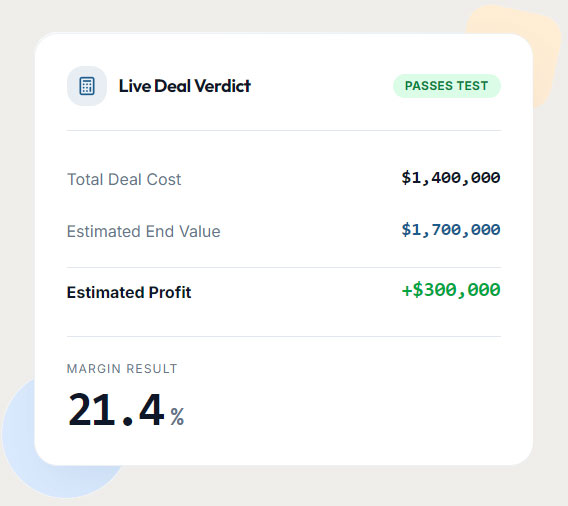
Know If a Property Deal Is Worth Pursuing, in Under 2 Minutes
Use the same framework experienced investors use to quickly filter renovation, subdivision, development and buy & hold deals, before wasting weeks on the wrong one.
0 thoughts on "The Hidden Cost Of Waiting For More Certainty"