The Quiet Advantage: How Boring Deals Will Beat Big Plays in 2026

The Deal That No One Noticed
One of my mentoring clients – let’s call him Dave – settled a modest one-into-two subdivision on the north side of Brisbane about eighteen months ago.
No flashy renderings, no press releases, no buzz in the Facebook groups.
While other investors were chasing big townhouse sites and multi-lot estates, Dave kept it simple.
Two blocks, quiet street, all services to the boundary, no overlays, clean drainage – the kind of site that wouldn’t make headlines but would definitely make money.
He wrapped it up in under ten months.
Titles issued, lots sold and a solid six-figure profit banked.
Meanwhile, a few of his mates were still knee-deep in complex, overcapitalised builds that looked great on Instagram but hadn’t yet delivered a cent.
That’s the quiet advantage.
The Myth of the Big Play
Every few years the property world goes through a “go big or go home” phase.
Investors get hooked on scale – unit sites, mixed-use projects, land estates – believing that bigger automatically means better.
But here’s what experience teaches you: The bigger the deal, the bigger the risk, the stress and the variables you can’t control.
– Finance gets harder.
– Council approvals take longer.
– Construction costs multiply.
– And one small delay can unravel the entire profit margin.
What’s worse is that many investors mistake complexity for progress.
They think if it looks impressive, it must be moving them forward… but progress isn’t about scale – it’s about reliability.
Why “Boring” Wins in 2026
The 2026 market is rewarding patience, precision and simplicity.
Banks have tightened up again, meaning the projects that get funded are the ones with low leverage and clean feasibility.
Council backlogs are still catching up so smaller DAs move faster through the system.
Build costs have steadied but remain volatile for complex designs… and buyers are flocking to affordable, functional homes – not architectural experiments.
Put simply, boring deals work because they finish.
While others are tied up for years in red tape, the quiet operators are cycling through one or two clean deals a year and stacking their profits while everyone else is still waiting for soil tests.
The Cost of Complexity
A few months back, I had a chat with another developer who’d been chasing larger-scale projects – triplexes, six-pack townhouses, small land estates.
On paper, the profits looked incredible but every deal had a drag factor:
- Council delays.
- Financing challenges.
- Holding costs climbing month by month.
- A builder that went bust halfway through.
He was burnt out and frustrated.
When we looked at his numbers, his total profit across three years was almost identical to what he could’ve earned doing two or three smaller, simpler deals in the same time – without the sleepless nights.
Sometimes the most expensive thing in property isn’t the deal you lose… it’s the one you drag out too long.
The Compounding Power of Simple Wins
Here’s the secret most investors miss – consistency compounds.
A small project completed cleanly gives you more than just profit.
It builds confidence, momentum and credibility – with brokers, councils, builders and future JV partners.
Every successful subdivision or renovation strengthens your systems and sharpens your instincts.
You get faster at due diligence, smarter with feasibility and clearer in your decision-making.
Do three or four of those in a row and suddenly you’ve built a serious track record – all without taking on unnecessary risk.
That’s how quiet operators build wealth while others chase noise.
How to Spot a “Quiet Winner” Deal
When I mentor investors, I encourage them to look for four green lights that signal a low-risk, high-certainty project:
- Short timeline.
From purchase to payday within 12 months. If it’s longer, your risk compounds. - Low holding costs.
You’re not bleeding cash waiting for approvals or builds. - Clear exit.
You can sell one or both end products to release capital fast. - Minimal dependencies.
The fewer third parties you rely on (builders, neighbours, external finance approvals), the smoother it goes.
The goal isn’t to find “perfect” deals – it’s to find doable ones.
The ones you can execute with calm confidence and repeat every year.
When Ego Gets Expensive
Let’s be honest, everyone loves a big win story… but ego has cost more investors money than the market ever will.
I’ve seen great operators get caught chasing validation instead of value – turning small wins into oversized commitments that chew up cash and energy.
There’s nothing wrong with ambition but there’s something powerful about restraint – about knowing when “enough” is actually plenty.
The best developers I know aren’t trying to impress anyone.
They’re quietly stacking profits, building teams and setting themselves up for long-term stability.
They’re not loud. They’re consistent.
A Mentoring Moment
When Dave finished that one-into-two project, he came to our mentoring session and said, “I almost didn’t buy it. It just seemed too simple.”
That stuck with me.
Because it’s easy to overlook the deals that look too easy… but those are often the ones that deliver the most dependable results.
Dave’s now moved onto another small site – different suburb, same model and he’s tracking to double his returns this year.
The difference?
He’s not trying to prove anything.
He’s just following a process that works.
What “Quiet Advantage” Really Means
In a noisy industry full of hype, restraint becomes your edge.
The quiet advantage is about clarity over chaos, quality over quantity and momentum over mayhem.
It’s about working smarter, finishing stronger and sleeping better at night.
So if you’re feeling pulled toward the next big shiny deal, pause for a moment and ask yourself:
Will this move me forward or just make me look busy?
Sometimes the smartest move isn’t scaling up… it’s doubling down on what already works.
Final Reflection
The investors who’ll win 2026 aren’t the loudest.
They’re the ones quietly stacking consistent wins, keeping costs tight and finishing what they start.
Because wealth isn’t built in giant leaps.
It’s built in steady, repeatable steps – the kind that don’t make headlines but do make freedom possible.
So this year, forget the flash.
Play the long game.
And remember – boring isn’t bad.
It’s profitable.
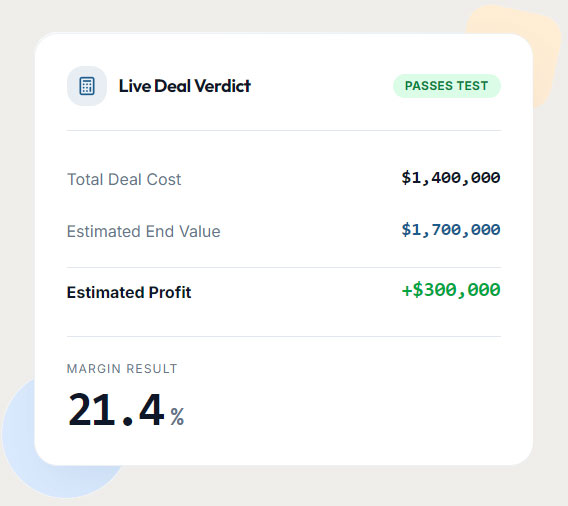
Know If a Property Deal Is Worth Pursuing, in Under 2 Minutes
Use the same framework experienced investors use to quickly filter renovation, subdivision, development and buy & hold deals, before wasting weeks on the wrong one.
We are grown to think complex.
Simple thinking is so difficult.
Love that perspective – it really hits home.
So much of what slows people down is overthinking and unnecessary complexity. The real progress usually comes when you strip things back, get clear and take the next simple step. Simple isn’t easy… but it’s powerful.