The Deal Funnel Most Investors Never Build And Why They Stay Stuck
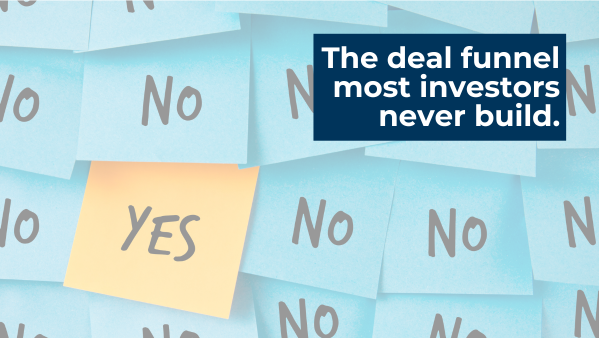
Most investors think they have a deal problem.
In reality, they have a funnel problem.
They’ll say things like, “There’s nothing out there” or “Good deals are too hard to find.” On the surface, that sounds like a market issue but when you look closer, it’s usually structural. They’re treating deal finding as a one-off event instead of a repeatable process.
And that changes everything.
The One-Deal Mentality
For many investors, the process goes like this.
They find a site that looks promising. They dive deep into it. They run detailed numbers, talk themselves into the upside and start picturing the finished product. Emotionally, they’re already in.
If the deal falls over, they’re back to zero. No backup. No pipeline. Just a reset.
That’s exhausting. Every opportunity carries too much weight because there’s nothing behind it. Subconsciously, you begin to need the deal to work.
And when you need it to work, your judgement shifts.
You negotiate with less conviction.
You start bending your own rules.
You downplay the warning signs.
Not because you’re reckless but because you’re attached.
When there’s only one deal in play, walking away feels like failure so you start justifying instead of evaluating.
What a Funnel Changes
A funnel removes that pressure.
Instead of analysing one site intensely, you screen many lightly. Most get rejected quickly using your front-end filter. A smaller number make it to rough feasibility. Fewer still progress to detailed analysis. One might eventually become an offer.
Now the psychology changes.
You’re not dependent on a single opportunity. You’re choosing between options.
That creates emotional stability. When another site is coming through next week, you don’t feel the same urgency to force the current one. You can assess calmly, negotiate properly and can walk away without it feeling dramatic.
Deal flow creates detachment and detachment leads to better decisions.
Why Most Investors Avoid Building One
Building a funnel feels like more work at the beginning. It requires consistency. You need to speak to more agents, review more listings, inspect more streets and reject more sites quickly.
That can feel inefficient.
But what’s actually inefficient is spending three weeks obsessing over a marginal deal because it’s the only one you’ve got.
There’s also a psychological reason people avoid this structure. A funnel removes the intensity. It turns deal finding into a process rather than an event. It feels less exciting, more procedural but that’s exactly the point.
If you want to operate like a developer, you need systems like a developer.
The Hidden Cost of Random Deal Hunting
When your deal flow is inconsistent, your confidence becomes inconsistent as well. One week you feel optimistic because something looks promising. The next week you feel flat because it didn’t stack.
That emotional volatility is draining.
It also increases the likelihood of mistakes. When nothing has worked for months, the temptation to lower your standards grows. You tell yourself it’s close enough, adjust the numbers slightly and rationalise risk.
A funnel protects you from that behaviour. It normalises rejection. It builds pattern recognition. Over time, you get faster and more accurate at spotting quality because you’ve seen volume.
What This Looks Like in Practice
You don’t need dozens of live deals but you do need consistent input.
That might mean reviewing five to ten potential sites each week and applying your front-end filter immediately. A few of those may deserve rough numbers. Most won’t. The goal isn’t to chase everything. It’s to create rhythm.
Regular contact with key agents helps so does committing to a weekly review window where deal screening becomes routine rather than reactive.
When there is flow, there is less pressure and when there is less pressure, there is better judgement.
Final Thought
If you feel stuck, ask yourself a harder question.
Do I genuinely have a deal problem or do I simply not have a funnel?
One-off opportunities create stress. A pipeline creates choice and choice is what gives you negotiating power, patience and long-term momentum.
The investors who move consistently aren’t necessarily seeing better deals.
They’re just seeing more of them.
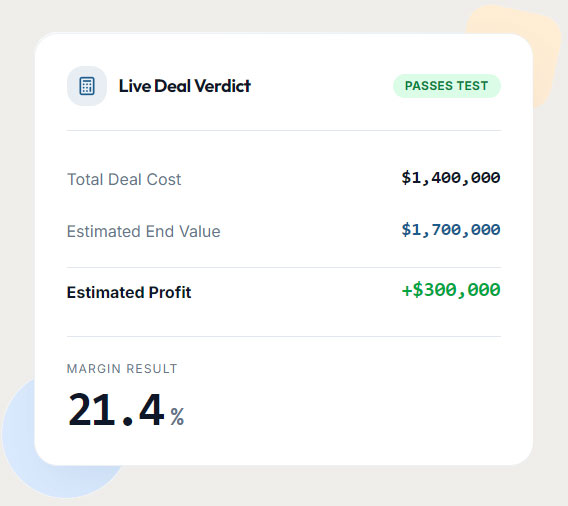
Know If a Property Deal Is Worth Pursuing, in Under 2 Minutes
Use the same framework experienced investors use to quickly filter renovation, subdivision, development and buy & hold deals, before wasting weeks on the wrong one.
0 thoughts on "The Deal Funnel Most Investors Never Build And Why They Stay Stuck"